FDA Approves Agilent’s PD-L1 Test to Guide KEYTRUDA Use in Esophageal and GEJ Carcinoma
28 March 2026
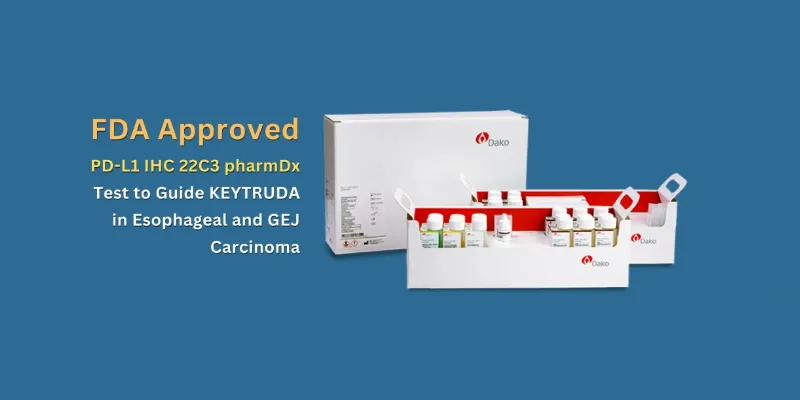
Agilent has received FDA approval for PD-L1 IHC 22C3 pharmDx, Code SK006, as a companion diagnostic to identify patients with esophageal or gastroesophageal junction carcinoma eligible for pembrolizumab. The assay detects tumors with PD-L1 CPS ≥1 and is the only FDA-approved test for this indication, expanding biomarker-guided treatment in a disease with poor survival.
Agilent Technologies announced that it has received U.S. Food and Drug Administration approval for PD-L1 IHC 22C3 pharmDx, Code SK006, as a companion diagnostic to help identify patients with esophageal or gastroesophageal junction carcinoma who may be eligible for treatment with pembrolizumab (KEYTRUDA), Merck’s anti-PD-1 therapy.
The approval allows clinicians to identify patients whose tumors express PD-L1 at a Combined Positive Score of at least 1. According to Agilent, the assay is now the only FDA-approved companion diagnostic specifically indicated for identifying patients with esophageal or GEJ carcinoma whose tumors meet this threshold and who may be considered for KEYTRUDA. The decision also marks the eighth FDA-approved companion diagnostic indication for PD-L1 IHC 22C3 pharmDx, Code SK006, in connection with KEYTRUDA.
The regulatory milestone expands the role of biomarker-driven testing in upper gastrointestinal cancers, where treatment selection increasingly depends on precise molecular and immunohistochemical characterization. In this setting, PD-L1 expression can help determine which patients may be candidates for immunotherapy-based treatment strategies.
“With the expanded FDA approval of PD-L1 IHC 22C3 pharmDx in esophageal or GEJ carcinoma, Agilent is proud to support clinicians in identifying patients eligible for treatment with KEYTRUDA,” said Nina Green, vice-president and general manager of Agilent’s Clinical Diagnostics Division. “This milestone reinforces Agilent’s commitment to advancing precision medicine and underscores its leadership in delivering trusted companion diagnostics that help enable treatment with anti-PD-1 therapies.”
KEYTRUDA is indicated for patients with locally advanced or metastatic esophageal or gastroesophageal junction carcinoma, defined as tumors with an epicenter 1 to 5 centimeters above the GEJ, when the disease is not amenable to surgical resection or definitive chemoradiation. In this population, the drug is used in combination with platinum- and fluoropyrimidine-based chemotherapy for tumors expressing PD-L1 with CPS of at least 1.
Agilent noted that PD-L1 IHC 22C3 pharmDx, Code SK006, is already indicated in several other tumor types, including non-small cell lung cancer, esophageal squamous cell carcinoma, cervical cancer, head and neck squamous cell carcinoma, triple-negative breast cancer, gastric or GEJ adenocarcinoma, and epithelial ovarian, fallopian tube, or primary peritoneal carcinoma.
The approval comes against a backdrop of substantial unmet need. In 2025, esophageal cancer was estimated to cause about 16,250 deaths in the United States, while the 5-year relative survival rate remained 21.9 percent. PD-L1 IHC 22C3 pharmDx, Code SK006, was developed by Agilent in partnership with Merck, as a companion diagnostic for KEYTRUDA.



Comments
No Comments Yet!