FDA Accepts IBTROZI sNDA After Durable Long-Term Benefit in Advanced ROS1+ Lung Cancer
Key Takeaways
- The FDA has accepted the sNDA for IBTROZI® (taletrectinib), which aims to update the drug’s label with longer-term data in advanced ROS1-positive non-small cell lung cancer.
- In TRUST-I, TKI-naïve patients achieved a median duration of response of 49.7 months and median progression-free survival of 49.6 months.
- In TRUST-II, TKI-pretreated patients had a median duration of response of 19.4 months.
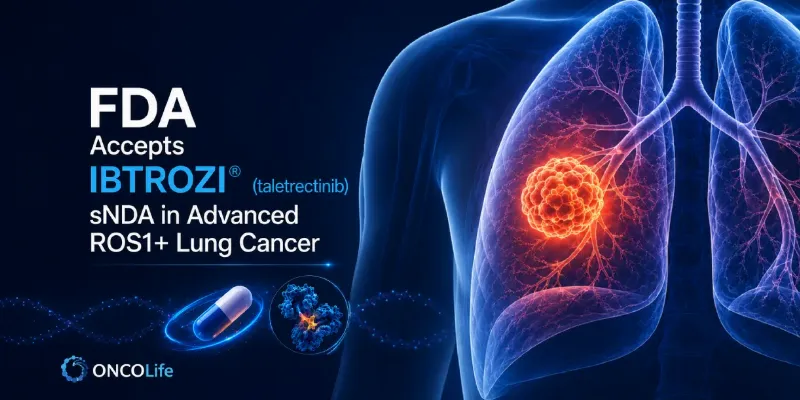
Nuvation Bio announced that the U.S. Food and Drug Administration has accepted its supplemental New Drug Application for IBTROZI® (taletrectinib), seeking to update the drug’s label with longer-term efficacy data in advanced ROS1-positive non-small cell lung cancer. The FDA has assigned a target action date of January 4, 2027.
The submission includes updated results from the pivotal TRUST-I and TRUST-II studies, with an August 2025 data cutoff and approximately 10 additional months of follow-up. According to Nuvation Bio, the application fulfills an FDA post-marketing commitment and is intended to update the efficacy information in the current IBTROZI label.
TRUST-I Data Show More Than Four Years of Response and PFS
In TKI-naïve patients enrolled in TRUST-I, IBTROZI demonstrated a median duration of response of 49.7 months and a median progression-free survival of 49.6 months. These data suggest more than four years of sustained clinical benefit in this patient population. In TKI-pretreated patients enrolled in TRUST-II, median duration of response was 19.4 months.
For TKI-naïve patients in TRUST-II, median duration of response had not yet been reached at the time of the August 2025 cutoff. Nuvation Bio noted that this result may change as the data mature. The updated findings were recently presented at the American Association for Cancer Research Annual Meeting 2026.
Safety Profile Remained Consistent With No New Signals
Importantly, the safety profile remained consistent with earlier reports, and no new safety signals were identified. The company said many patients continued treatment for extended periods without disease progression, including some who remained on therapy for multiple years. For clinicians treating ROS1-positive NSCLC, these longer-term data may help clarify the durability of response and tolerability profile of taletrectinib across treatment lines.
"These longer-term data for IBTROZI—which show an impressive median duration of response of more than four years in TKI-naïve patients, mirrored by the progression-free survival results and supported by a consistent safety profile—reinforce our belief that IBTROZI is becoming the new standard of care in advanced ROS1+ NSCLC," said David Hung, M.D., Founder, and CEO of Nuvation Bio. “The breadth and maturity of these data give both patients and providers even greater confidence when selecting IBTROZI.”
IBTROZI Positioned as a CNS-Active Next-Generation ROS1 Inhibitor
IBTROZI is an oral, selective, next-generation ROS1 inhibitor designed to be CNS-active. The FDA granted full approval to the drug in June 2025 for adults with locally advanced or metastatic ROS1-positive NSCLC across lines of therapy. The approval followed Priority Review and Breakthrough Therapy Designations in both first-line and second-line or later settings.
Beyond the United States, taletrectinib is approved for advanced ROS1-positive NSCLC in Japan, where it is marketed by Nippon Kayaku, and in China, where it is marketed by Innovent Biologics as DOVBLERON®. In March 2026, Nuvation Bio and its partner Eisai also announced that the European Medicines Agency had validated the Marketing Authorisation Application for taletrectinib for full approval consideration under a standard review timeline.
TRUST Program Expands Across Advanced and Early-Stage ROS1+ NSCLC
The TRUST clinical program includes several registrational studies evaluating taletrectinib. TRUST-I and TRUST-II are Phase 2 single-arm studies in adults with advanced ROS1-positive NSCLC. TRUST-I enrolled 173 patients in China, while TRUST-II enrolled 189 patients globally. The primary endpoint in both studies is confirmed objective response rate assessed by an independent review committee.
About ROS1+ NSCLC
ROS1-positive disease represents a small but clinically important subgroup of non-small cell lung cancer (NSCLC). While NSCLC is the most common form of lung cancer, approximately 2% of patients have ROS1-positive tumors. CNS involvement remains a major treatment challenge: about 35% of patients newly diagnosed with metastatic ROS1-positive NSCLC have brain metastases, and the brain is also the most common site of disease progression, with CNS metastases occurring in about 50% of previously treated patients.


Comments
No Comments Yet!