Perioperative Durvalumab Regimen Improves EFS and OS in Muscle-Invasive Bladder Cancer
Key Takeaways
- In the Phase III VOLGA trial, perioperative Imfinzi plus neoadjuvant enfortumab vedotin significantly improved event-free survival and overall survival versus radical cystectomy-based standard care in cisplatin-ineligible or cisplatin-declining muscle-invasive bladder cancer.
- The Imfinzi, Imjudo and enfortumab vedotin regimen also improved EFS, with a favourable but not yet statistically significant OS trend at interim analysis.
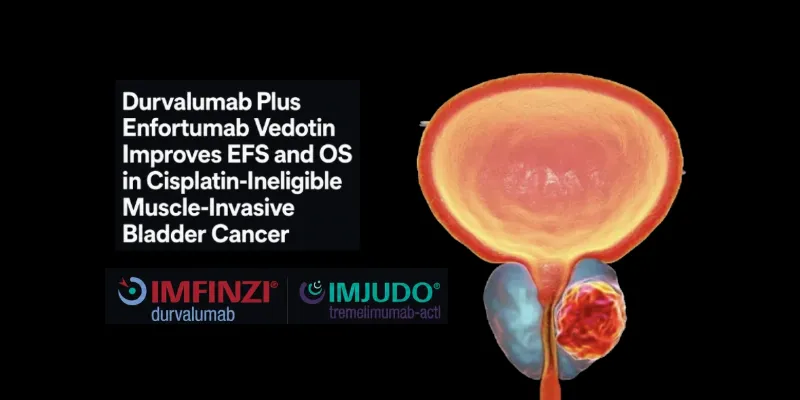
A planned interim analysis of the Phase III VOLGA trial has shown that perioperative Imfinzi (durvalumab) combined with neoadjuvant enfortumab vedotin significantly improved event-free survival and overall survival compared with standard of care in patients with muscle-invasive bladder cancer who were ineligible for, or had declined, cisplatin-based chemotherapy.
The results mark a potentially important advance for a difficult-to-treat group of patients, many of whom currently undergo radical cystectomy without cisplatin-based neoadjuvant chemotherapy. In VOLGA, patients in the comparator arm received radical cystectomy, with or without approved adjuvant treatment.
A Perioperative ADC-Immunotherapy Strategy
VOLGA evaluated a perioperative strategy built around immune checkpoint inhibition and antibody-drug conjugate therapy. The trial included 695 patients randomised 1:1:1 across three arms. One experimental arm received three cycles of Imfinzi and enfortumab vedotin, plus two cycles of Imjudo (tremelimumab) before surgery, followed by adjuvant Imfinzi and one cycle of Imjudo. The second experimental arm received three cycles of Imfinzi and enfortumab vedotin before surgery, followed by adjuvant Imfinzi monotherapy. The comparator arm received radical cystectomy, with or without approved adjuvant therapy.
Event-Free Survival as a Primary Endpoint
The dual primary endpoints were event-free survival for each experimental arm versus the comparator arm. EFS was defined broadly, including recurrence after radical cystectomy, progression in patients who did not undergo surgery, failure to undergo cystectomy in patients with residual disease, or death from any cause. Secondary endpoints included overall survival, pathologic complete response, disease-free survival and pathologic downstaging.
“Up to half of patients with muscle-invasive bladder cancer are not eligible for cisplatin and face high rates of disease recurrence, even after having their bladder removed, leaving a significant need for new effective and well-tolerated treatments,” Dr. Thomas Powles, Professor, Chair of Barts Cancer Centre, Queen Mary University of London, and International Coordinating Investigator for VOLGA. “The VOLGA results show that perioperative durvalumab significantly extends event-free survival and overall survival when combined with neoadjuvant enfortumab vedotin, with a manageable safety profile, compared to surgery for patients in this curative-intent setting.”
Significant EFS and OS Gains Reported
According to AstraZeneca, perioperative Imfinzi plus neoadjuvant enfortumab vedotin produced statistically significant and clinically meaningful improvements in both EFS and OS versus standard of care. The regimen combining perioperative Imfinzi plus Imjudo with neoadjuvant enfortumab vedotin also showed a statistically significant and clinically meaningful improvement in EFS, with a favourable trend in OS. However, OS for the Imfinzi, Imjudo and enfortumab vedotin arm was not statistically significant at this interim analysis and will be reassessed in a subsequent analysis.
Susan Galbraith, Executive Vice President, Oncology Haematology R&D at AstraZeneca, said: “This interim analysis from the VOLGA trial highlights the benefit of perioperative Imfinzi with neoadjuvant enfortumab vedotin compared to surgery, a novel regimen that optimises treatment options for patients. Together with NIAGARA and POTOMAC, VOLGA is our third positive readout in bladder cancer, setting a strong foundation for Imfinzi as the immunotherapy backbone in this early-stage, curative-intent setting.”
Safety findings were consistent with the known profiles of Imfinzi, Imjudo and enfortumab vedotin, with no new safety signals identified. Full data from VOLGA are expected to be presented at a forthcoming medical meeting and shared with global regulatory authorities.
The findings add to a growing body of evidence supporting durvalumab-based perioperative and adjuvant strategies in bladder cancer. Imfinzi is already approved in more than 40 countries for cisplatin-eligible MIBC based on the Phase III NIAGARA trial. In high-risk non-muscle-invasive bladder cancer, Imfinzi plus Bacillus Calmette-Guérin therapy met the primary endpoint of disease-free survival in the Phase III POTOMAC trial and is under regulatory review in several regions.
Although detailed efficacy data, subgroup analyses and longer follow-up remain important, the interim results suggest that perioperative durvalumab plus neoadjuvant enfortumab vedotin may represent a new therapeutic pathway for cisplatin-ineligible or cisplatin-declining patients undergoing radical cystectomy.
About Muscle-invasive bladder cancer
Muscle-invasive bladder cancer represents roughly one quarter of all bladder cancer cases and is defined by tumour invasion into the muscle wall of the bladder without distant metastasis. For patients fit enough to receive it, cisplatin-based chemotherapy can improve outcomes. However, up to half of patients with MIBC are not eligible for cisplatin because of renal impairment, comorbidities or other clinical factors. For this population, radical cystectomy alone has historically remained a key treatment option, despite substantial recurrence risk and poor prognosis.









Comments
No Comments Yet!