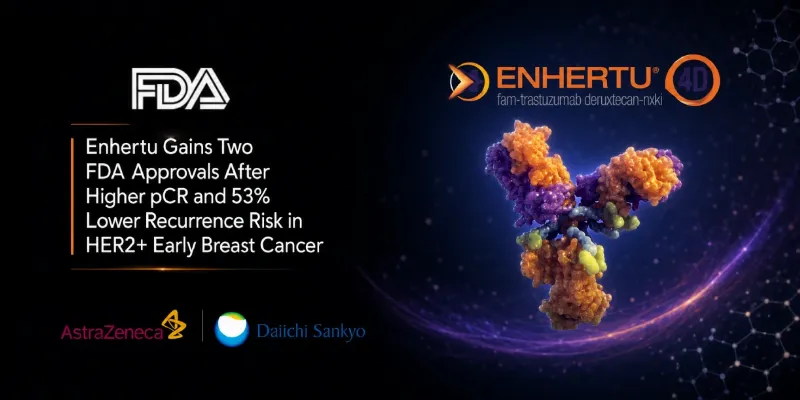
FDA Approves Enhertu for Two New HER2-Positive Early Breast Cancer Indications
16 May 2026
Key Takeaways
- The FDA approved Enhertu (trastuzumab deruxtecan) for two HER2-positive early breast cancer indications: neoadjuvant T-DXd followed by THP in Stage II or III disease and adjuvant T-DXd for residual invasive disease after neoadjuvant therapy.
- DESTINY-Breast11 showed higher pCR, 67.3% versus 56.3%, while DESTINY-Breast05 reduced invasive recurrence or death by 53% versus T-DM1.
AstraZeneca and Daiichi Sankyo announced that the US Food and Drug Administration, FDA, has approved Enhertu (trastuzumab deruxtecan) for two new indications in adults with HER2-positive early-stage breast cancer, expanding the HER2-directed antibody drug conjugate into both neoadjuvant and adjuvant curative-intent treatment settings based on results from the DESTINY-Breast11 and DESTINY-Breast05 Phase III trials.
T-DXd Approved for Neoadjuvant Treatment in Stage II or III HER2+ BC
The first approval covers T-DXd followed by a taxane, trastuzumab and pertuzumab, THP, for the neoadjuvant treatment of adults with HER2-positive, IHC 3+ or ISH+, Stage II or III breast cancer, as determined by an FDA-authorized test. The second approval covers adjuvant T-DXd for adults with HER2-positive breast cancer who have residual invasive disease after neoadjuvant trastuzumab, with or without pertuzumab, and taxane-based therapy.
The agency also approved two companion diagnostics for identifying eligible patients: PATHWAY anti-HER-2/neu, 4B5, Rabbit Monoclonal Primary Antibody, and VENTANA HER2 Dual ISH DNA Probe Cocktail.
A Shift into Earlier-Stage Disease
HER2-positive breast cancer is biologically aggressive, but outcomes have improved substantially with anti-HER2 therapy. The new approvals are notable because they bring Enhertu into treatment settings where therapy is given with curative intent, before or shortly after surgery.
“HER2-positive breast cancer is an aggressive disease, and our goal is to reduce the risk of recurrence for patients as early as possible to achieve the best long-term outcomes. The neoadjuvant setting offers the earliest opportunity to improve outcomes, while the adjuvant setting provides another important chance to prevent recurrence for patients with residual disease after surgery. These two new indications in HER2+ early breast cancer will evolve how we treat patients in these settings and support trastuzumab deruxtecan as a potential new standard of care in early-stage disease.” said Dr. Shanu Modi, Medical Oncologist, Memorial Sloan Kettering Cancer Center,
DESTINY-Breast11: higher pCR in the neoadjuvant setting
The neoadjuvant approval is supported by DESTINY-Breast11, a global, randomized, open-label Phase III trial enrolling 927 adults with HER2-positive, high-risk, early-stage breast cancer. Patients were randomized to receive T-DXd for four cycles followed by THP for four cycles, dose-dense doxorubicin and cyclophosphamide followed by THP, or another investigational regimen.
The major efficacy endpoint was centrally assessed pathological complete response, defined as absence of invasive cancer in the breast and axillary lymph nodes after surgery. T-DXd followed by THP achieved a pCR rate of 67.3%, compared with 56.3% for ddAC-THP, a statistically significant improvement of 11.2 percentage points. The FDA noted that EFS and OS were not statistically controlled or powered in this trial, and that DESTINY-Breast05 provided supportive evidence for the neoadjuvant indication.
Ken Keller, Global Head of Oncology Business, and President and CEO, Daiichi Sankyo, Inc. said: “Enhertu has redefined the treatment of HER2-expressing breast cancer with practice-changing data across six breast cancer indications in seven years. Enhertu is now approved in the US across both early and metastatic HER2-positive breast cancer, accomplishing what we set out to achieve a little over a decade ago for patients at the start of our comprehensive clinical development programme.”
DESTINY-Breast05: Reduced Recurrence Risk After Residual Disease
The adjuvant approval is based on DESTINY-Breast05, a global, randomized, open-label Phase III trial in 1,635 adults with HER2-positive breast cancer and residual invasive disease after neoadjuvant therapy. Patients were assigned to receive either T-DXd or trastuzumab emtansine, T-DM1, for up to 14 cycles.
T-DXd reduced the risk of invasive disease recurrence or death by 53% compared with T-DM1, with a hazard ratio of 0.47. At three years, invasive disease-free survival was 92.4% with T-DXd and 83.7% with T-DM1. Disease-free survival showed a similar benefit, 92.3% versus 83.5%, also with a hazard ratio of 0.47. At the time of the IDFS analysis, 47 patients, 2.9% across both arms, had died.
Based on DESTINY-Breast05, trastuzumab deruxtecan has also been included in NCCN Guidelines as a Category 1 recommended adjuvant option for patients with HER2-positive early breast cancer with residual disease and high recurrence risk after preoperative therapy.
Safety Considerations Remain Central
No new safety concerns were identified in DESTINY-Breast11 or DESTINY-Breast05. In DESTINY-Breast11, T-DXd followed by THP showed similar rates of drug-related adverse events and ILD or pneumonitis compared with ddAC-THP, with lower rates of Grade 3 or higher adverse events, serious adverse events, treatment interruptions, left ventricular dysfunction and hematologic toxicities.
In DESTINY-Breast05, overall drug-related adverse events and Grade 3 or higher adverse events were similar between T-DXd and T-DM1. However, adjudicated drug-related ILD or pneumonitis occurred more often with T-DXd, 9.6% versus 1.6%. Most events were low grade, but the T-DXd arm included seven Grade 3 events and two Grade 5 events.
Dave Fredrickson, Executive Vice President, Oncology Haematology Business Unit, AstraZeneca, said: “HER2-positive early disease is considered highly curable, however up to one in four patients still experience disease recurrence, underscoring the need for new options in this setting. These approvals mark an important step forward, expanding the possibility of cure to more patients for the first time in many years and positioning Enhertu as a foundational treatment in early breast cancer.”
Together, these approvals extend Enhertu beyond metastatic HER2-positive breast cancer and into earlier treatment phases, where improving pCR and reducing post-surgical recurrence may have long-term clinical consequences for patients at risk of relapse.





Comments
No Comments Yet!