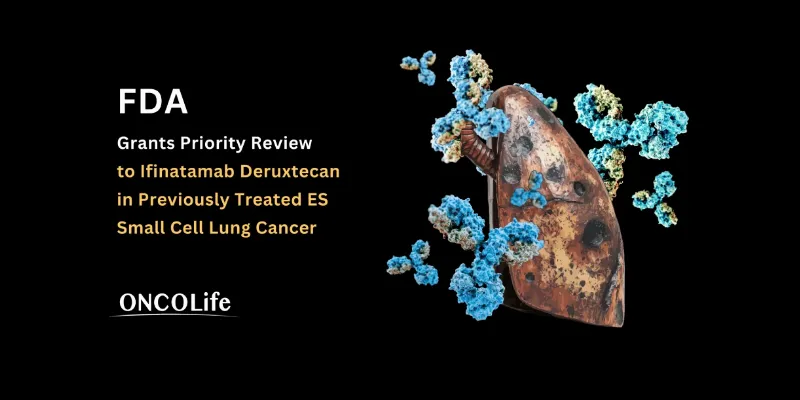
FDA Grants Priority Review to Ifinatamab Deruxtecan in Pretreated ES-SC Lung Cancer
13 April 2026
Key Takeaways
- FDA granted Priority Review to ifinatamab deruxtecan for previously treated ES-SCLC after platinum-based chemotherapy.
- If approved, it would be the first B7-H3 directed DXd ADC in this setting.
- The BLA is supported by IDeate-Lung01 phase 2, with support from IDeate-PanTumor01 phase 1/2.
- IDeate-Lung01 enrolled 187 patients; FDA action date is October 10, 2026.
The U.S. Food and Drug Administration has accepted and granted Priority Review to the biologics license application for ifinatamab deruxtecan in adults with extensive-stage small cell lung cancer, ES-SCLC, whose disease progressed on or after platinum-based chemotherapy. If approved, the agent would become the first B7-H3 directed DXd antibody-drug conjugate available for this setting.
The application was submitted by Daiichi Sankyo and Merck and is being reviewed under the FDA’s Real-Time Oncology Review program and Project Orbis, two pathways intended to accelerate access to promising oncology therapies. The agency’s target action date under the Prescription Drug User Fee Act is October 10, 2026.
The filing is primarily supported by the phase 2 IDeate-Lung01 trial, with additional support from the phase 1/2 IDeate-PanTumor01 study. Results from the primary analysis of IDeate-Lung01 were presented at the 2025 World Conference on Lung Cancer and published in the Journal of Clinical Oncology. The drug had already received Breakthrough Therapy Designation from the FDA in August 2025 for the same ES-SCLC population.
Small cell lung cancer remains one of the most aggressive thoracic malignancies, and treatment options after platinum-based chemotherapy are limited. In that context, B7-H3 has emerged as a notable target. The transmembrane protein is overexpressed across multiple tumor types, including SCLC, and higher expression has been associated with poor prognosis. There are currently no approved B7-H3 directed cancer therapies.
“The FDA’s granting of Priority Review for ifinatamab deruxtecan marks a significant milestone in our effort to provide new and innovative treatment options for patients with extensive-stage small cell lung cancer,” said John Tsai, MD, Global Head, R&D, Daiichi Sankyo. “We look forward to continuing to work with the FDA to bring this potential first-in-class B7-H3 directed DXd antibody drug conjugate to patients as quickly as possible.”
Ifinatamab deruxtecan is an investigational antibody-drug conjugate built on Daiichi Sankyo’s DXd platform. It combines a humanized anti-B7-H3 IgG1 monoclonal antibody with a topoisomerase I inhibitor payload, DXd, linked through a tetrapeptide-based cleavable linker.
“Small cell lung cancer remains one of the toughest cancers to treat, with few options if the disease progresses after standard of care treatments,” said Eliav Barr, MD, Senior Vice President, Head of Global Clinical Development and Chief Medical Officer, Merck Research Laboratories. “The FDA’s acceptance of the BLA reinforces the important role that ifinatamab deruxtecan could play in helping to address the needs of patients with extensive-stage small cell lung cancer.”
About IDeate-Lung01 and IDeate-PanTumor01 Trial
IDeate-Lung01 is a global, multicenter, randomized, open-label phase 2 study in patients with ES-SCLC who had received at least one prior line of platinum-based chemotherapy and up to three prior lines of treatment. Importantly, patients with asymptomatic brain metastases, whether untreated or previously treated, were eligible. The study enrolled 187 patients across Asia, Europe, and North America. Its primary endpoint is objective response rate by blinded independent central review per RECIST v1.1, while secondary endpoints include duration of response, progression-free survival, disease control rate, time to response, overall survival, pharmacokinetics, and safety. The supportive IDeate-PanTumor01 trial is a first-in-human, open-label phase 1/2 study evaluating the drug in advanced or metastatic solid tumors that are refractory or intolerable to standard therapy, or for which no standard treatment exists.



Comments
No Comments Yet!