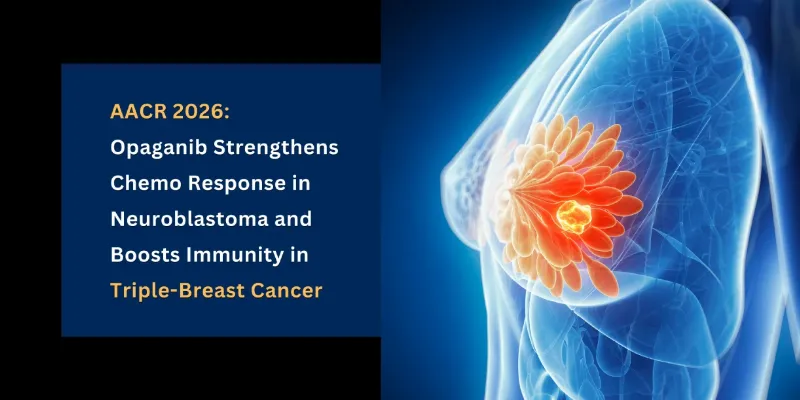
Opaganib Shows Dual Preclinical Promise in Neuroblastoma and Triple- Breast Cancer
22 April 2026
Key Takeaways
- New preclinical data presented at AACR 2026 suggest opaganib may improve outcomes in two hard-to-treat cancers.
- In high-risk neuroblastoma models, it enhanced oxaliplatin plus doxorubicin activity by destabilizing n-Myc and promoting apoptosis.
- In triple-negative breast cancer, opaganib pre-treatment boosted STING-mediated immune effects after low-dose diABZI, supporting further study of this oral agent as a combination therapy.
RedHill Biopharma announced that independent investigators presented two posters showing potential benefits for opaganib as an add-on treatment. In neuroblastoma models, opaganib was shown to enhance the activity of the oxaliplatin plus doxorubicin, OXDOX, chemotherapy combination.
The studies indicated that opaganib directly destabilized n-Myc, a key oncogenic driver in neuroblastoma and other solid tumors. This effect was linked to increased ceramide production, which promoted apoptosis in cancer cells. Because n-Myc is strongly associated with aggressive disease and poor outcomes, the findings suggest that opaganib may help improve the efficacy of chemotherapy in high-risk disease.
A second preclinical study in triple-negative breast cancer (TNBC) pointed to a possible immune-enhancing effect. In vitro data showed that pre-treatment with opaganib, followed by low-dose diABZI, potentiated downstream STING-mediated signaling. Because TNBC remains the breast cancer subtype with the poorest prognosis, the ability to augment anti-tumor immunity could be particularly relevant in future combination strategies.
"These data represent exciting findings that could hold promise for improving outcomes in treating pediatric NB and TNBC, providing additional encouragement for further exploration. Opaganib has previously shown potential as add-on therapy in several preclinical oncology models in combination with chemotherapy. Moreover, the ongoing Phase 2 clinical study of opaganib in combination with darolutamide in advanced prostate cancer could potentially provide paradigm-shifting clinical data in support of the additive use of opaganib in a cancer setting." said Dr. Mark Levitt, Chief Scientific Officer at RedHill.
Opaganib, also known as ABC294640, is a first-in-class investigational oral selective sphingosine kinase-2, SPHK2, inhibitor. The drug is being developed across multiple disease areas, but the latest AACR data reinforce its potential relevance in cancer, particularly as an add-on agent designed to enhance the activity of established therapies or support anti-tumor immune responses.
The drug has already received FDA Orphan Drug and Rare Pediatric Disease designations for neuroblastoma, underscoring continued interest in its development for rare childhood cancers. Opaganib is also being studied in an ongoing randomized Phase 2 trial in combination with darolutamide for metastatic castration-resistant prostate cancer, while a Phase 1 chemoradiotherapy study protocol is prepared for FDA IND submission.





Comments
No Comments Yet!