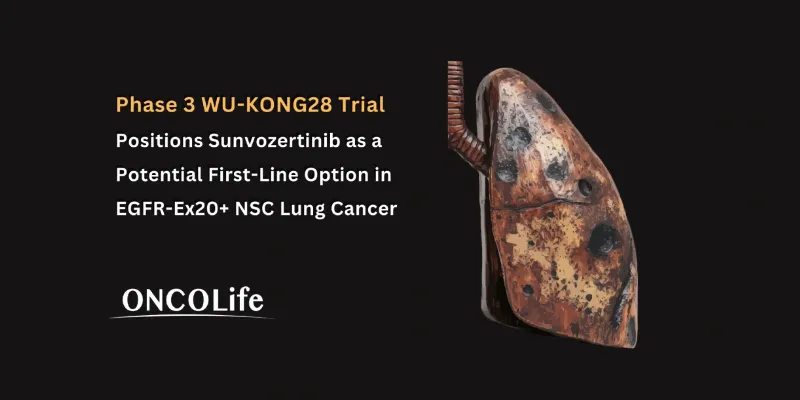
Phase 3 WU-KONG28 trial met its primary endpoint, showing that once-daily oral sunvozertinib significantly improved progression-free survival over platinum-based doublet chemotherapy in first-line advanced non-small cell lung cancer with EGFR exon 20 insertion mutations. The drug also showed superiority across objective response, and disease control, with a tolerability profile consistent with earlier studies, multinational topline results.
Dizal has announced positive topline results from the multinational Phase 3 WU-KONG28 trial, showing that sunvozertinib (ZEGFROVY) significantly improved progression-free survival over platinum-containing doublet chemotherapy in the first-line treatment of advanced non-small cell lung cancer (NSCLC) harboring EGFR exon 20 insertion mutations.
The study met its primary endpoint, with progression-free survival assessed by blinded independent central review. According to the company, sunvozertinib also outperformed chemotherapy across key secondary endpoints, including confirmed objective response rate, duration of response, and disease control rate. The safety profile was described as generally well tolerated and consistent with earlier studies.
These findings are notable because EGFR exon 20 insertion mutations remain one of the more difficult molecular subsets in lung cancer to target effectively. Standard first-line treatment has largely relied on platinum-based chemotherapy, and no oral targeted monotherapy has previously shown phase 3 benefit in this setting.
"The positive topline results from WU-KONG28 study represent an important advancement for treating patients with EGFR exon20ins NSCLC," said Prof. Caicun Zhou, PhD of Shanghai East Hospital and the principal investigator of the study. “ZEGFROVY is currently the only single-agent, small-molecule targeted therapy approved in both China and the United States for patients with EGFR exon 20 insertion NSCLC. In this Phase 3 trial, first-line treatment with ZEGFROVY significantly prolonged PFS compared to platinum-based doublet chemotherapy. These results suggest that ZEGFROVY may offer an effective and convenient treatment option for treatment-naïve patients with EGFR exon20ins NSCLC.”
WU-KONG28 was an open-label, randomized confirmatory trial conducted across 16 countries and regions in Asia, Europe, North America, and South America. The trial compared once-daily oral sunvozertinib monotherapy with platinum-based chemotherapy in treatment-naïve patients with advanced NSCLC carrying EGFR exon 20 insertion mutations. Detailed results from the primary analysis are expected to be presented at an upcoming international scientific congress.
"Finding a drug targeting EGFR exon 20 insertion mutations is especially challenging due to their enormous heterogeneity. We have identified over 100 different subtypes of EGFR exon20ins clinically. Despite tremendous efforts, there is no success yet in finding an effective target drug that can spare patients from chemotherapies. WU-KONG28 study has the potential to change all that." said Dr. Xiaolin Zhang, CEO of Dizal. "The success of this multinational pivotal study further validates ZEGFROVY's potential as first-line therapy for patients with EGFR exon20ins NSCLC. We look forward to sharing comprehensive data with the global scientific community."
Sunvozertinib is an irreversible EGFR inhibitor designed to target a broad spectrum of EGFR mutations while maintaining selectivity for wild-type EGFR. It is already approved in the United States and China for adults with locally advanced or metastatic NSCLC with EGFR exon 20 insertion mutations whose disease has progressed on or after platinum-based chemotherapy. In the first-line setting, the agent has received Breakthrough
Therapy Designation from both the U.S. FDA and China’s Center for Drug Evaluation.
Based on the WU-KONG28 results, Dizal said it plans to engage with regulatory authorities regarding potential new drug applications for the first-line setting.





Comments
No Comments Yet!