Teclistamab plus Daratumumab Achieves an 83% Risk Reduction in R/R Multiple Myeloma
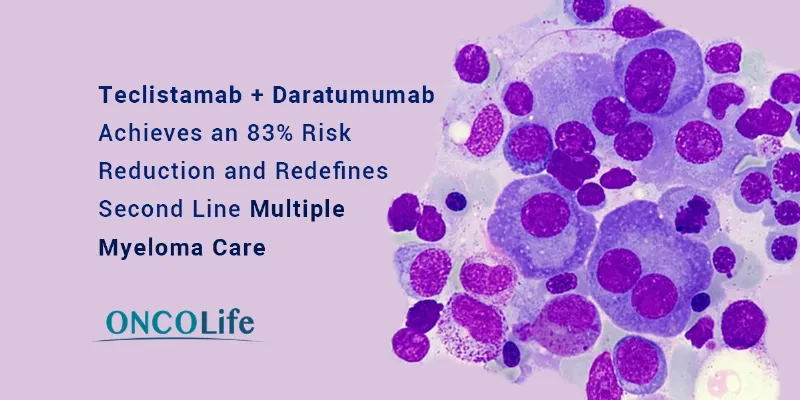
The Phase 3 MajesTEC 3 trial showed that teclistamab plus daratumumab reduced the risk of progression or death by 83% and achieved an 83.4 percent three year PFS rate in relapsed or refractory multiple myeloma, far surpassing standard regimens. The combination delivered markedly higher complete responses, deep MRD negativity, and an overall survival advantage, supporting a potential new second line standard.
Johnson & Johnson announced late breaking results from the Phase 3 MajesTEC 3 study that position the combination of TECVAYLI® (teclistamab cqyv) plus DARZALEX FASPRO® (daratumumab and hyaluronidase fihj) as one of the most compelling advances in relapsed or refractory multiple myeloma in recent years. Presented at the 2025 ASH Annual Meeting and published simultaneously in the NEJM, the findings show an extraordinary and durable benefit that may redefine treatment standards as early as second line.
At a median follow-up of 34.5 months, progression free survival with teclistamab plus daratumumab surpassed expectations by a wide margin. The combination reduced the risk of progression or death by 83% compared with DPd or DVd regimens (hazard ratio 0.17, 95 percent CI 0.12 to 0.23, P<0.0001). Three year PFS reached 83.4% versus 29.7% with standard therapy, a separation rarely seen in myeloma trials. Notably, 91% of patients who were progression free at six months maintained disease control at three years, illustrating the regimen’s depth and durability of response.
These results stem from a randomized trial of 587 patients who had received one to three prior lines of therapy. The investigational combination was compared with daratumumab and dexamethasone plus either pomalidomide or bortezomib, representing widely used standards for relapsed disease.
"The combination offers remarkable efficacy, a well-characterized safety profile with robust infection management protocols, and an opportunity to improve patient outcomes across academic and community settings. It has the potential to change the standard of care as a steroid-sparing combination regimen suited for outpatient administration on the familiar DARZALEX schedule," said Dr. Maria-Victoria Mateos, Consultant Physician in Hematology, University Hospital of Salamanca. “TECVAYLI and DARZALEX FASPRO work synergistically by uniquely targeting both BCMA and CD38 to prime and activate the immune system. The combination has shown to extend progression-free survival and overall survival versus standard of care as early as second line.”
Across all key secondary endpoints, the combination showed consistent superiority. Complete responses or better occurred in 81.8% versus 32.1% with DPd or DVd. Overall responses reached 89% compared with 75.3%, while MRD negativity by next generation sequencing was achieved in 58.4% versus 17.1%. Overall survival also favored the combination, with a hazard ratio of 0.46 and estimated three year survival of 83.3% compared with 65% in the control arm. Patients receiving teclistamab plus daratumumab remained symptom free significantly longer, supporting a measurable improvement in quality of life outcomes.
"With these data, we are entering a new era in treating multiple myeloma with the first bispecific combination to demonstrate superior overall survival as early as second line. Alongside the other transformational therapies in our leading portfolio, we can offer patients optimal outcomes at any stage of disease – bringing us closer to our ultimate ambition to find a cure," said Dr. Sen Zhuang, M.D., Vice President, Oncology Clinical Research, Johnson & Johnson Innovative Medicine. “With TECVAYLI plus DARZALEX FASPRO we have the potential to set a new standard of care once again for this disease.”
Safety findings aligned with known profiles of both agents. Rates of Grade 3 or 4 adverse events were comparable between study arms, driven mainly by cytopenias and infections. Infections were more frequent with the investigational combination, although established immunoglobulin supplementation and prophylaxis protocols reduced the incidence of severe infections after the first six months. Cytokine release syndrome occurred in 60.1% of patients, all Grade 1 or 2, and was managed successfully without treatment discontinuation. Neurotoxicity was rare at 1.1%. Treatment discontinuation rates due to adverse events remained low at 4.6%.
These outcomes support the FDA’s Breakthrough Therapy Designation for the teclistamab and daratumumab combination and ongoing global regulatory submissions. The U.S. FDA is reviewing the supplemental Biologics License Application under the Real Time Oncology Review program, which aims to accelerate evaluation for therapies with strong potential to improve patient outcomes.
MajesTEC 3 adds significant momentum to the evolution of bispecific antibodies in multiple myeloma. By targeting BCMA and CD38 simultaneously, teclistamab and daratumumab appear to generate deeper and more durable immunologic control than either pathway alone. For clinicians managing relapsed disease, the prospect of a chemotherapy free, steroid sparing regimen with this level of efficacy represents a major step toward more effective and more tolerable long term disease management.








Comments
No Comments Yet!