Preoperative Radiation May Improve Immune Response in HR+ HER2- Breast Cancer
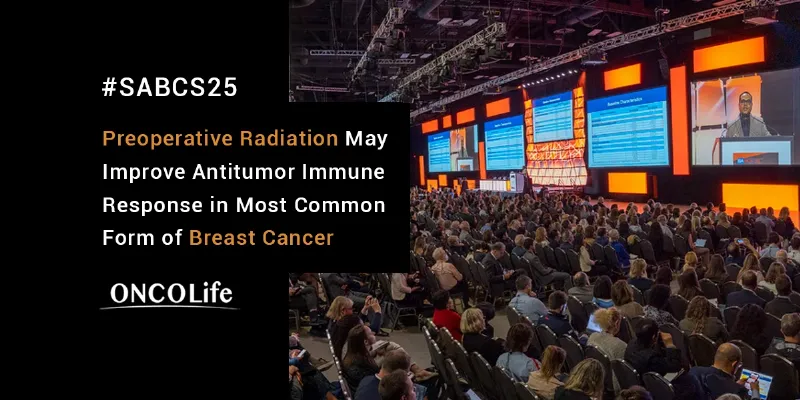
Preoperative radiation boosted antitumor immunity and treatment response in HR positive, HER2 negative breast cancer in the phase II P RAD trial presented at SABCS 2025. When combined with pembrolizumab and chemotherapy, radiation increased high quartile T cell infiltration to 53 percent at 24 Gy and improved nodal clearance and surgical response trends, supporting radiation as a potential immune priming strategy before surgery.
Preoperative radiation improved T-cell infiltration (TCI) in patients with hormone receptor (HR)-positive, HER2-negative breast cancer when administered in combination with pembrolizumab (Keytruda) and chemotherapy and led to improved treatment responses prior to surgery, according to the results of the phase II P-RAD clinical trial presented at the San Antonio Breast Cancer Symposium 2025
“Many patients with HR-positive, HER2-negative breast cancer—the most common type of breast cancer—experience late recurrences, and there is a critical need to improve outcomes for this patient population” said presenter Gaorav Gupta, MD, PhD, associate professor of radiation oncology and coleader of the Breast Cancer Research Program at the University of North Carolina Lineberger Comprehensive Cancer Center. “Immunotherapy has shown early signs of promise, but new strategies are needed to make it more effective in this form of breast cancer. Immune checkpoint inhibitors depend on TCI to counter cancer effectively, and based on previous research that showed radiation-mediated TCI improvement, we aimed to test that in breast cancer.”
In this clinical trial, Gupta and colleagues from the Translational Breast Cancer Research Consortium enrolled patients with HR-positive, HER2-negative breast cancer that had spread to the regional lymph nodes. The median patient age was 49.5, with an age range of 23 to 78. They randomly assigned 51 patients 1:1:1 to receive either no radiation, a low dose of radiation (9 Gy), or a high dose of radiation (24 Gy) together with pembrolizumab prior to initiating chemotherapy. Patients received radiation doses administered over the course of three days.
All patients went on to receive 12 weeks of pembrolizumab and paclitaxel, followed by four cycles of pembrolizumab and doxorubicin and -cyclophosphamide. The researchers assessed two coprimary endpoints: TCI at the time of a biopsy taken two weeks after radiation and pathologic complete response in the lymph nodes (ypN0) at the time of definitive surgery to remove the cancer. Secondary endpoints were pathologic complete response (pCR) and residual cancer burden.

Following radiation and immunotherapy treatment, in the 49 patients evaluable for TCI, the proportion of tumors with the highest quartile of TCI increased depending on the radiation dose: 31%, 40%, and 53% in the 0 Gy, 9 Gy, and 24 Gy arms, respectively.
The median TCI increased for all patients after they received treatment, meaning that radiation allowed more T cells to enter and attack the tumor. However, only patients in the 24 Gy arm experienced a statistically significant improvement in TCI compared to untreated tumors.
Gupta and colleagues also observed dose-dependent responses in the lymph nodes. For all 48 evaluable patients, the rate of tumor clearance from surgically removed lymph nodes was 29%, which showed an increasing trend with radiation dose: 24% at 0 Gy, 29% at 9 Gy, and 33% at 24 Gy.
Secondary endpoints likewise improved with increases in radiation doses. pCR and residual cancer burden rates were 18% and 27% respectively, for all patients. By arm, they were 6% and 18% at 0 Gy; 29% and 29% at 9 Gy; and 19% and 33% at 24 Gy. Due to the limited number of patients, these differences in surgical response rates did not achieve statistical significance.

Modern radiation therapy is safe, precise, and widely available for breast cancer treatment. Our study suggests that radiation could be used in a new way—to ‘prime’ the immune system and enhance the effects of immunotherapy in HR-positive, HER2-negative breast cancer,” said Gupta. “We found early evidence that a focused radiation dose of 24 Gy given over three days, when combined with pembrolizumab, can boost immune activity and may improve tumor clearance before surgery. These results lay the groundwork for future clinical trials exploring this promising approach to improve long-term outcomes for breast cancer patients.”
The study’s limitations include the limited number of enrolled participants. The study was funded by Merck, the Breast Cancer Research Foundation, the Translational Breast Cancer Research Consortium, the Susan G. Komen Foundation, and the Department of Defense Breast Cancer Research Program. Gupta has received research funds from both Merck and Breakpoint Therapeutics, and he also receives royalty payments from Naveris, Inc. Gupta discloses an ownership stake in Naveris, Inc.




Comments
No Comments Yet!