AI Nodule Detection Helps Sarasota Memorial Reach 75% Early Lung Cancer Diagnosis
Key Takeaways
- Sarasota Memorial reported that 75% of lung cancers diagnosed through its early detection program were found at Stage I or II.
- The program used AI to review more than 430,000 radiology reports annually and flag incidental pulmonary nodules.
- From 2022 to 2025, the program evaluated more than 9,000 patients and diagnosed 144 lung cancers, 67% of them at an early stage.
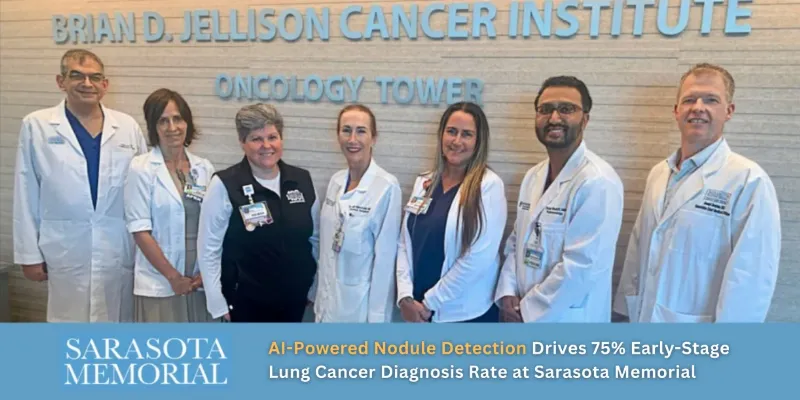
Sarasota Memorial Health Care System has reported a sharp improvement in early lung cancer detection after broadening its case-finding strategy beyond conventional screening. According to the health system, 75% of lung cancers diagnosed through its early detection program in 2025 were identified at Stage I or II, the most treatable stages of disease. That figure is more than double the reported national average of 28% and nearly triple Florida’s average of 25.8%.
The program, based at Sarasota Memorial’s Brian D. Jellison Cancer Institute, reflects a practical shift in lung cancer detection: not relying only on formal screening programs for current and former smokers, but also capturing suspicious lung findings discovered incidentally on scans ordered for other reasons.
"Diagnosing lung cancer early is the single, most important thing we can do to save lives," said Dr Joseph Seaman, associate chief medical officer at Sarasota Memorial and a pulmonologist who helped develop SMH's early detection program. “When detected early, in Stage I or II, 70% of lung cancer patients will survive five years or more. When it's found very late (Stage IV), the 5-year survival rate drops to just 10%.”
That difference in survival underpins the rationale for the program. While screening remains essential, many at-risk patients are never captured through elective screening pathways. Sarasota Memorial sought to close that gap by using Eon’s AI-enabled platform to detect incidental pulmonary nodules mentioned in radiology reports across the health system.
These incidental nodules are often found on imaging performed for unrelated reasons, such as emergency care after trauma or scans of nearby structures that include part of the lungs. Eon’s platform reviews more than 430,000 radiology reports annually across Sarasota Memorial’s inpatient and outpatient network, flagging suspicious findings in real time and directing them to the lung team for review. The aim is to reduce referral delays and trigger coordinated follow-up before patients are lost in the system.
SMH first launched its lung cancer screening program in 2016 and expanded enrollment over time through outreach and education. But the addition of real-time incidental finding detection appears to have changed the scale of case identification substantially.
"We knew there was more we could do for our community. Our imaging volumes are enormous. We just needed a reliable way to flag incidental findings in real time so we could proactively reach all of the people who could benefit from earlier evaluation," said Amie Miller, MSN, APRN, program lead for the early detection program at SMH's Jellison Cancer Institute.
After the platform was integrated, incidental findings referred to the screening team rose from an average of 1 to 2 per week to more than 170 per week. Between 2022 and 2025, the early detection team evaluated more than 9,000 patients across both screening and incidental pathways and diagnosed 144 lung cancers, 67% of them at Stage I or II. In 2025 alone, the team diagnosed 53 lung cancers, with 75% found at those earlier stages.
The results point to the importance of system-level detection strategies in lung cancer, where diagnosis often occurs too late for curative treatment. By identifying patients through routine care, rather than waiting for them to enter formal screening programs, health systems may be able to detect more cancers when surgery or definitive local therapy is still possible.
Dr. Aki Alzubaidi, CEO and founder of Eon, said SMH's approach demonstrates the opportunity to improve outcomes and address incidental findings earlier by pairing multidisciplinary clinical expertise with AI technology that supports early detection and longitudinal care management.
"By ensuring every at-risk patient is identified and receives follow-up, Sarasota Memorial's program is improving outcomes at both the individual and community level," Dr. Alzubaidi. “It offers a scalable model for improving early detection through real-time identification of incidental pulmonary nodules, standardized guideline-based follow-up pathways, and longitudinal monitoring to ensure patients complete recommended care.”



Comments
No Comments Yet!