Long-Term Data Show Taletrectinib Delivers High Response Rates in ROS1+ NSCLC
23 April 2026
Key Takeaways
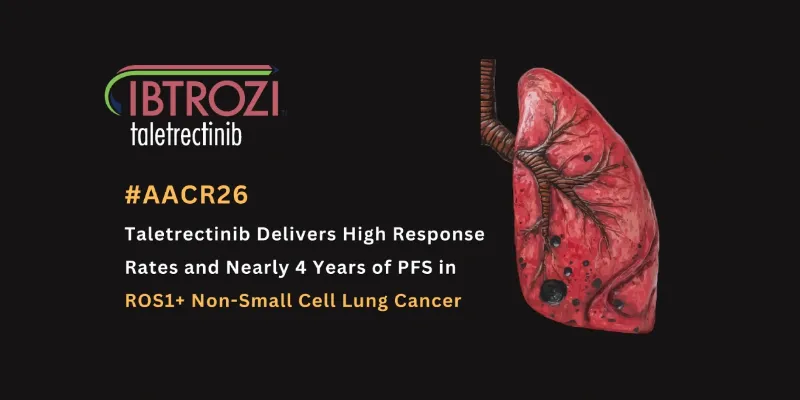
- Long-term pooled results from TRUST-I and TRUST-II trials show taletrectinib delivers durable benefit in advanced ROS1-positive NSCLC, with an 89.8% response rate, 49.7-month median duration of response, and 46.1-month median progression-free survival in TKI-naïve patients.
- The drug also showed strong intracranial activity, with a 76.5% brain response rate in TKI-naïve patients and 65.6% in TKI-pretreated patients with brain metastases.
- Safety remained manageable, with low discontinuation rates and no new safety signals.
Nuvation Bio announced results from a pooled analysis of long-term follow-up data from the pivotal TRUST-I and TRUST-II trials of taletrectinib (IBTROZI®) in patients with advanced ROS1+ non-small cell lung cancer, NSCLC. The trial data suggest that taletrectinib may provide unusually durable disease control, particularly in patients who have not previously received a ROS1 tyrosine kinase inhibitor, TKI.
The updated data, presented at AACR Annual Meeting 2026 and supported by the Phase II TRUST-I publication in the Journal of Clinical Oncology, also reinforce the agent’s intracranial activity and manageable safety profile.
ROS1+ NSCLC Carries a High Risk of Brain Metastases
ROS1+ NSCLC is a rare molecular subtype, accounting for about 2% of NSCLC cases, but it carries a substantial risk of central nervous system involvement. Brain metastases are present in roughly 35% of patients at diagnosis of metastatic disease, and the CNS remains a common site of progression. In that setting, long-lasting systemic and intracranial control is a central therapeutic goal.
Pooled TRUST Data Show Durable Responses
The pooled long-term analysis combined data from the Phase II TRUST-I and TRUST-II studies. Among 157 TKI-naïve patients, taletrectinib achieved a confirmed objective response rate of 89.8%, with a median duration of response of 49.7 months and a median progression-free survival of 46.1 months. Median overall survival had not yet been reached. In patients with brain metastases, the intracranial response rate was 76.5%.
Taletrectinib Also Demonstrates Activity After Prior ROS1 TKI Treatment
Activity was also seen in previously treated patients. In the pooled TKI-pretreated group of 113 patients, the confirmed objective response rate was 55.8%, median duration of response was 16.6 months, and median progression-free survival was 9.7 months. Median overall survival was 29.8 months. Intracranial response rate in those with brain metastases was 65.6%. Most pretreated patients had received entrectinib or crizotinib before study entry.
"Achieving durable responses is a primary goal in treating ROS1-positive lung cancer. These extensive follow-up data with this next-generation ROS1 inhibitor show high rates of responses that last more than four years for many patients, and a median progression-free survival that's nearly just as long," stated Professor Lyudmila Bazhenova, Medical Oncologist at UCSD School of Medicine and investigator for the TRUST-II study. “Critically, the data demonstrated robust intracranial activity without the significant central nervous system toxicities that often limit the long-term use of other brain-penetrant therapies, and a favorable safety profile that allowed patients to stay on treatment and continue to benefit.”
TRUST-I Long-Term Follow-Up Confirms Lasting Benefit
The TRUST-I abstract provides a more detailed look at the China cohort with extended follow-up. In 103 TKI-naïve patients treated at 600 mg once daily, with a median follow-up of 51.0 months, the objective response rate was 90.3%, while median duration of response and progression-free survival both exceeded four years, at 49.7 and 49.6 months, respectively. Median overall survival was not reached. In 66 crizotinib-pretreated patients, with median follow-up of 45.2 months, objective response rate was 51.5%, median duration of response was 13.2 months, median progression-free survival was 7.6 months, and median overall survival was 25.6 months.
Safety Profile Remains Manageable With No New Signals
Safety findings remained consistent with earlier reports. Across the pooled analysis, adverse events of clinical interest, including diarrhea, nausea, vomiting, and dizziness, were generally low grade and resolved quickly. Treatment discontinuation due to treatment-emergent adverse events was 8.5%, and no new safety signals emerged with longer follow-up.
"Our objective was to redefine the standard of care for advanced ROS1-positive NSCLC, and we believe IBTROZI is delivering on that promise," said Dr. David Hung, Founder and Chief Executive Officer of Nuvation Bio. “In these updated long-term clinical data presented at AACR, IBTROZI demonstrated remarkable durability, underscored by the long mDOR and mPFS seen in ROS1+ TKI-naïve patients. And new preclinical data suggest that taletrectinib inhibits critical pathways that can lead to metastasis. When you combine these benefits with its favorable safety profile, you have a treatment that we believe addresses the disease from all angles.”
AACR also featured preclinical data suggesting taletrectinib may have effects beyond ROS1 inhibition alone. Investigators reported that the drug inhibited lung cancer cell migration and reduced expression of key markers linked to epithelial-mesenchymal transition, findings that point to possible suppression of metastatic behavior through TRKB-related mechanisms.



Comments
No Comments Yet!